Wednesday, 23 July 2014

74% of World Cup Viewers Use Social Media During the Games

It’s no surprise that social media has become one of the most important tools for marketers to leverage during live events and sports games.  Social gives brands the power to engage and influence consumers second by second.
In an effort to seize real-time opportunities and become part of the social conversation during the World Cup, marketers will be connecting with their consumers through #hashtags, “brand newsrooms” will be abuzz with trending topics, and consumers will be prompted to share ads across their networks.
In fact, the World Cup is already prepared to be the most social sporting event ever.
Mashable recently reported that this year’s World Cup ads have already been shared more than the 2014 Super Bowl commercials. With all the content brands are pushing out, it’s a smart move for brands to get involved in creative ways.
This recently released “Social Side of the World Cup” infographic shows that, from a poll of over 850 men and women, 74.2% of viewers will be on social media during the World Cup. After the games, 42% of viewers are likely to be posting about their favorite ads and 52% are likely to follow or like a brand.
One way to engage in social influence is to find your brand’s advocates and leverage them. Remember that  92 percent of people trust the recommendations they receive from friends and family above all other forms of advertising. This means that you can push your content out to your audience, but it may go unnoticed unless someone they trust tells them to pay attention.
Search your customer relations management systems and followers on social channels. Your repeat buyers and social followers already posting positive mentions about your brand are your advocates. Develop partnerships with them to create and share branded, user-generated content (UGC), which increases your credibility.
The World Cup is heating up for brands, and the best social strategy will take the gold.
crowdtap world cup infographic FINAL 74% of World Cup Viewers Use Social Media During the Games

Amplify Your Content Strategy with Influencer Marketing

Most of us are familiar with the concept of influencer marketing, i.e., marketing to a select group of individuals — such as journalists, bloggers, consultants, or industry analysts — who influence your buyers’ decisions. The idea is that if you take the time to identify and build relationships with those influencers, you can leverage them to build your credibility. That, in turn, can help move your buyers down the path to purchase. Just think of the Oprah Winfrey effect. If you were to market your product to her and get her seal of approval, her endorsement would go a long, long way toward boosting your sales.Ok, I admit it, Oprah is an extreme and unlikely example. Most influencers that businesses target, especially B2B businesses, probably aren’t world famous media moguls. But just because you don’t have Oprah on your side doesn’t mean that influencer marketing isn’t an incredibly useful tactic, particularly when it comes to turning up the volume on your content strategy. In fact, getting the influencers your target buyers listen to to contribute content to your site, write about you on their site, or simply share your latest eBook, can make your life a lot easier.
Let me use OpenView Venture Partners as an example. We have spent the past few years building a substantial content factory that relies heavily on influencers. Our community site, OpenView Labs, features new content from influencers every week about the topics our target audience cares about, such as sales and marketing. The benefits of doing so are threefold:
  • Getting great content for free — We regularly ask influencers to write articles for us, record videos and podcasts, or simply contribute quotes and ideas to our eBooks and reports. It certainly doesn’t get any better (or easier) than posting great content that you’re getting for free.
  • Building our brand — By virtue of the fact that these influencers are choosing to publish content on our site, they are effectively signaling their approval of OpenView. Chances are that if industry influencers think we’re worth checking out, our target audience will too.
  • Expanding our reach — Because we have content from a wide range of influencers, each of whom shares their content with their diverse groups of followers, we get people coming to the site who probably otherwise wouldn’t. We get a steady stream of new visitors to our site every day.
To be sure, integrating influencer marketing into your content strategy is a great way to accelerate your content marketing efforts. But how do you actually go about doing so? Here are the five points you need to keep in mind:
      1. Start by figuring out who influences your buyers and which of those influencers you want to target. In addition to talking to your sales teams and your buyers themselves, there is a lot of detective work that you can do online. For example, using a simple list of relevant keywords can help you identify a broad list of influencers. Likewise, you can search on Twitter and LinkedIn as well as use PR tools such as Vocus and Cision to find influencers. If you are looking for bloggers specifically, Google Blog Search and Technorati can also be valuable resources.
      2. Once you have identified a list of influencers, prioritize them based on who you think will have the most impact, focusing your efforts on just a few at a time. You will then need to figure out how to build a relationship with those influencers. The simplest approach is to initially engage them in some small way and establish periodic touch points with them over time. You might start by commenting on one of their blog posts one week, following them on Twitter the next, and retweeting their content for several weeks after that.
      3. Eventually, you reach the point where you send them a personalized e-mail that explains that you have been following them for a while and would like to introduce yourself and your business. This is the time to share your best elevator pitch that quickly tells them who you are, what you’re looking for, and what’s in it for them. At OpenView, our pitch goes something like this: OpenView is a Boston-based venture capital firm that produces a lot of content for entrepreneurs. We’d love to collaborate with you on an article on topic X, which we think our audience would really enjoy hearing from you on. In addition, to posting the article to our sites, which get more than 120,000 visitors a month, we will also include it in our newsletter that goes out to our 20 portfolio companies around the country and over 20,000 entrepreneurs. As you can see, it’s a great opportunity to get exposure to a broad audience.
      4. The key to successfully engaging influencers is making the process of working with you as easy as possible for them. For example, if you’re looking for an influencer to contribute the foreword to your new eBook, rather than ask them to write something for you from scratch, why not write the first draft yourself, giving them the opportunity to simply personalize it as they see fit. Chances are they’d much rather spend 30 minutes editing what you’ve written than hours (they don’t have) coming up with it on their own.
      5. Lastly, once you have posted a new piece of content that an influencer has contributed to, be sure to e-mail that influencer to thank them for their work and to ask them to share the content with their audience. You might also follow up with them in the days that follow to let them know if their content performed particularly well, if there are comments for them to respond to, or even to tee up another opportunity to contribute content down the road.
Influencer marketing is a great way to help your content marketing efforts take off. Invest the time up front to build good relationships with the right influencers and incorporate those influencers into your strategy. Do so, and the fruits of your labor will start paying off quickly.

How to Promote Your Content Across Owned, Earned, and Paid Media

Content marketing evangelists have spoken – “Create great content that appeals to your customers and you’ll profit.”
While this is true, marketers often forget the importance of promoting their content – people don’t find content by mistake, or by accident. Every content plan needs a complementary promotion plan that combines paid, owned, and earned media.

Beyond Simple Sharing on Corporate Social Accounts

I was watching a video where one content marketing evangelist went through the strategy and creation of content in great detail, but completely ignored the importance of promoting content.
He suggested that marketers should share it from corporate social accounts and with employees so they could choose to share if they wanted.
While these strategies are an acceptable start, they overlook the simple fact that for the vast majority of companies (unless you’re a market-leading megabrand), simply publishing content gets them nothing resembling good results.
It’s like writing the great American novel and leaving it on your doorstep. Or creating a baseball diamond in a cornfield in Kansas. Only in the movies do random strangers find your great things and make them a big deal. In the real world, you have to work hard to get anyone to pay attention to what you’re doing.
But that’s why marketers have jobs right?

Building Your Promotion Plan Across Paid, Earned and Owned Media

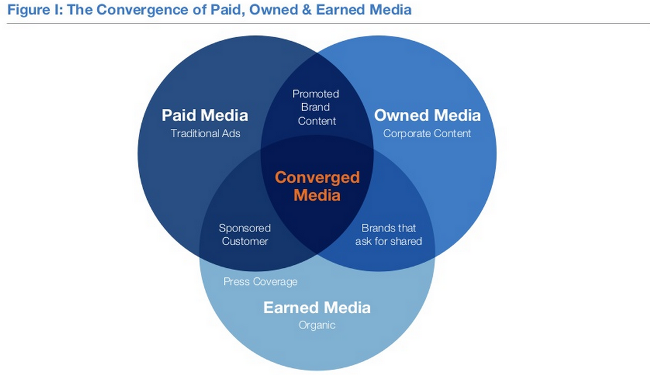
While it’s become a something of a buzzword, thinking about your content promotion plan in the ‘Paid-Earned-Owned’ matrix is a useful cognitive pattern.
altimeter poe chart How to Promote Your Content Across Owned, Earned, and Paid Media
The Altimeter Group Converged Media Model
Across your company’s paid, owned, and earned channels, how will you promote your beautiful piece of content? How will you get the word out and ensure the right people see it and share it? This can’t be taken care of when your content has been written – these questions have to be answered before you ever start your content creation efforts.

Owned Media: Using Your Permission Marketing Assets

We’ll start with owned assets – they tend to be the simplest to discuss in this context.
Most companies have:
  • Some sort of social media presence (be it Facebook, Twitter, LinkedIn, Pinterest, Tumblr, etc.)
  • Email lists – of both customers and non-customers
  • Blog(s)
  • A more static website or series of microsites
Content marketers should develop a plan to promote their content in a unique, platform-native way across all of these assets.
For instance, if you’ve developed an infographic, create some extracts from it with interesting statistics. These make great social updates for Twitter or LinkedIn.
By contrast, for Facebook, you may wish to crop an image of the relevant part of the infographic and share it along with the interesting statistic to take advantage of the prominence that image-centric posts are given in Facebook’s newsfeed.
Finally, if you’re working on content for your website or blog, you can cut up the infographic into its component pieces, and write a blog post that elaborates on each statistics and explains it in greater detail.
You’ll also want to email a link to your list (sometimes in a larger newsletter). At BuzzStream, we’ve found that sharing our best content with our customers via email is an excellent way to get social distribution.
All of these materials should link back to the original graphic. (Incidentally, it’s a good idea to add Twitter Card and Facebook OGP metadata to that page.  It’s also effective to host the graphic on a CDN if you’ll ask people to embed it. Taking the time to follow best practices can make content marketing practices dramatically more effective.)
While infographics are often put in the “fun and easy” bucket (they are fun to do well, and easy to do poorly), most of this advice applies to whitepapers, detailed visualizations of internal data, and other pieces of content.

Paid Media: Buying Attention at Bargain Basement Prices

Integrating paid media in content marketing is a topic of much debate – doesn’t the content marketing do that itself?
If you take one thing away from this blog post, the answer is No. Nothing markets itself. The world tends towards entropy, ignorance, and forgetting your company exists.
That being said, I’m not suggesting you hire someone in a gorilla suit to stand by the side of the freeway holding a sign with the title of your latest white paper on it.
gorilla suite How to Promote Your Content Across Owned, Earned, and Paid Media
Photo Credit: Gorilla Suit
The White Paper is in his briefcase.
Why? For starters, it would be difficult to attribute conversions to the person in the gorilla suit. And our tests indicate gorilla suit advertisements convert poorly.
Most direct marketing advertisement methods (paid search, etc.) deliver poor ROIs for content advertising. They’re too expensive, and often deliver people who have the wrong need-state for enjoying some quality content.
Some paid content promotion tactics that can be very effective include:
  • StumbleUpon Paid Discovery – StumbleUpon lets you buy clicks at low, low prices fromsocially engaged visitors. These visitors are typically in the college demographic, and are often looking for engaging visual content. Made a new piece of visual or interactive content in a B2C space targeting younger people? This tactic is a great fit.
  • Reddit Ads  - Similar to StumbleUpon ads, Reddit also has inexpensive clicks from a young, socially engaged audience available. Remember to follow the protocol of the sub-Reddit you’re advertising on– for example, use the AMA or TIL conventions on the relevant subreddits.
For more tips on Reddit and StumbleUpon ads, I recommend this great SlideShare presentation by Brent Csutoras.
  • Promoted Tweets – Twitter now allows you to promote individual tweets, which can be a great way to get in front of the right people and join the social conversation. You can target users by interest, gender, geographic, or device – so you can get in front of the right people.
  • Highly Targeted Facebook Ads – Facebook enables marketers to target both posts and conventional ads by an amazing variety of criteria. For content promotion, you might want to target people that like WordPress, blogs, or employees of media properties like TechCrunch or Mashable.
  • Outbrain – Outbrain is another content promotion ad network – you can advertise for inexpensive traffic on related blogs for audience development.
  • Retargeting on Display or Facebook – If you have a retargeting list, you can advertise your content to it inexpensively on AdRoll, or through Google Retargeting.
If you’re interested in building links specifically (and who isn’t), you may enjoy this video presentation from Carson Ward, where he used Reddit and other social ads to promote his content and found he got links at a very affordable price:
When you approach these paid opportunities, they take a slightly different mentality than traditional brand advertisements or direct response ads.  You want to encourage people to engage with the content, comment on it, and share. Questions work well, as does taking a page from the social aggregators and asking people to “Check this out” or “Let Us Know What You Think”.

Earned Media: Embracing the Echo Chamber

Earned media is some of the most valuable – and hardest to get – exposure due to its credibility and potential reach. While you might not see the same level of message control, the amount of trust placed in these recommendations is huge.
Earned media can take several forms:
Social Sharing from Individual Accounts
This could happen on networks like LinkedIn, Twitter, Pinterest, Tumblr, Facebook, and whatever the kids are using these days. As far as efficacy, these can very from “Oh, that’s nice,” to driving site-crashing levels of traffic and corresponding increases in sales.
Pickups in Traditional or Trade Media 
These are conventional PR placements, but in this case, they’re about your content. What this looks like will depend on your industry – I’ve seen successes range from TechCrunch reporting on aggregated mobile analytics data to USA Today writing about studies from drug rehab centers.
In some (mostly B2B) verticals, pickups in trade media can be more effective than coverage in larger, general interest papers.
Bloggers and Other Influencers Writing About Your Content
These aren’t traditional media but rather individual bloggers writing about your content. There isn’t a hard and fast line between individual bloggers and ‘real’ media anymore – what starts one place can rapidly go to another, and now it’s easy for individual blogger’s posts to get picked up by traditional media.
If you do a lot of outreach to these smaller influencers, you may want to use a tool like BuzzStream to find these people and manage your process.
Prominent Placements on Aggregator Sites Like HackerNews, Reddit, etc.
These sites can send LOTS and LOTS of traffic, especially the two examples above. However, these exist for just about every niche – sometimes they don’t send a lot of traffic, but even if they don’t they’re a good place to reach the curators and other online influencers.
These categories aren’t mutually exclusive anymore.  In the past there was a hard line between press, customers, bloggers, analysts, etc., but now everyone is part of one big group of people with online audiences. A story that starts on Twitter gets submitted to HackerNews, picked up on TechCrunch, and then blogged about on smaller publications, etc.
Whenever you launch a piece of content, you should plan for some sort of earned media promotion.
While that can mean letting relevant content curators and writers know you’ve published something good, the best approach is to bake earned media appeal into your content.
What does that mean?
  • Create “citable” content – use high-authority research from scientific journals and sources to back up your content. (Greg Ciotti, Chris Dyson, and Derek Halpern all do this very well.)
  • Consider where each part of your sub-sections may make a good guest post. For example, if I were to create an ebook about the ‘ultimate guide to content promotion’, I’d try to write a guest post related to the content section on Content Marketing Institute, the social section on Convince & Convert, and the search section on SEOmoz. In each of these sections, I’d make sure I mention those organizations and link back to their most important and useful pieces of content. Then when I approached them for a guest post, I would be in a better position, and visitors from those posts downloading the ebook would feel at home and trust the rest of the content.
  • Encourage social sharing – consider making 140 character insights tweetable with one click thru Twitter Web Intents. Also, suggest people follow you on the second click so you can build your audience.
  • At the same time, get your metadata right so you look good when shared on social networks – use OGP tags for Facebook and Twitter Card metadata.
  • Make a list of publications you want coverage from before you start writing or outlining your content – observe what these people cover and modify your content to match their themes.
  • If your content has visual elements, consider licensing them with creative commons and/or making them easy to embed. If you decide to make them embeddable, don’t go nuts on the anchor text – no point in making a mess that you may have to clean up later.

Fusion, Amplification, and Converged Media

In the past, these media types were deeply siloed. Now, they effortlessly flow into one another, where paid promotion of owned media can lead to massive earned media wins, and paid and owned media can amplify earned media and give something with credibility incredible reach.
Planning for Fusion
In a perfect world, your owned and paid media touch off a tornado of earned media, creating that ‘echo chamber effect’ where your content (and thus your brand) appears to be everywhere.
While there are a variety of strategies to do this, ultimately you want to get your initial earned, owned, and paid media out into your audience, and hopefully that will lead to more self-sustaining earned media.
This gets you scale and trust – without SuperBowl sized budgets.
Always remember: Earned media is the most important. Anything a brand or marketer says is immediately suspect, but trusted third parties are just that – trusted third parties. This makes amplifying an earned media win dramatically more valuable than a comparable amplification of owned media or straight paid media.
To create this sort of amplification, use your owned and paid power to boost your earned wins, after pushing your original content.
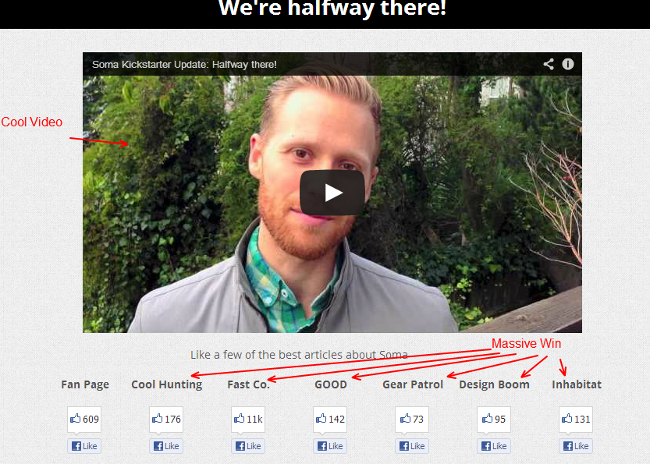
For example, the creators of beautiful water filter Soma used this page as part of their Kickstarter campaign to invite their email list to like their press wins on Facebook. Earned amplified by Owned = Massive Win:
Soma Example of Earned Media Amplification1 How to Promote Your Content Across Owned, Earned, and Paid Media
The whole post where they describe their process is a fascinating example of scaled PR outreach – it’s especially applicable if you like KickStarter, design, or startups.
If you can get a quality earned media win – like a great guest post or a story – immediately after your campaign starts, consider promoting it through paid media and on your own lists. This is a good strategy because:
  • More people get exposed to your ideas, your brand, and your content.
  • Many publications maintain a “Most Read” or “Most Shared” internal sidebar – as your article climbs this, it will drive more traffic to your content as time goes on.
  • Additionally, many publications these days are largely ad driven – if the set of topics around your ‘sweet spot’ becomes widely known at that publication as something that drives traffic, it’s likely you’ll appear in future coverage.
  • That win sets you up with social proof to approach other publications with your content and get even bigger earned media wins.
The other tip I can’t recommend enough is to add retargeting pixels to your content as early as possible. These retargeting lists are free to create, and will come in handy when you need to either move your content consumers down a purchasing path, or launch a new piece of content – you can advertise to everyone that interacted with your last piece for a very affordable rate.

Conclusion

Just because you’ve made something great doesn’t mean people will find out about it on their own. Developing a plan to promote your content across paid, earned, and owned media before you even create it is not just a best practice – it’s necessary to be an effective content marketer.

Why Great Marketing Isn’t Always Done “At Scale”

ry to popular belief, marketing doesn’t necessarily need to be a “scalable” operation. In fact, outreach marketing focuses on the “one to one to many” approach where brands reach out to a handful of passionate fans, influencers, etc. who spread word of mouth recommendations for them.Nothing is black and white, especially marketing.  However, for the most part, outreach marketing is not a philosophy that encourages at scale operations.
Instead, it is a philosophy that holds on to the roots of how marketing started and what makes consumers buy in the first place. It weaves it all in to the modern technology that has made word of mouth marketing smother self-promotional tactics like billboards and commercials.
Because this philosophy works best when relationships are ongoing and nurtured – and I know this may be bold – but I always advise my clients to reach out to just a few people instead of attempting some scalable marketing tactic so that these relationships can be maintained, tracked, and nurtured for the most sincere and organic brand coverage possible.

Work With a Few Right People Instead of Many People

I’m not going to waste your time talking about what makes the ideal influencer for your brand, but I will say that I firmly believe in contextual qualifiers over numeric ones.
I want to share some quick examples of brands who do a great job working with the right influencers and nurturing those relationships instead of doing mass outreach.
The following brands don’t follow the philosophy that “everyone wears clothes” or “everyone eats” or other such things brands tell themselves to mass email bloggers. Instead, they reach out to influencers based on a very specific affinity to ensure that they are reaching a super targeted network.
  • Char-Broil has a group of “All-Stars” who are bloggers who write about grilling and they work with them on an ongoing basis and maintain really close communication. They don’t have hundreds by any means, just a handful of awesome bloggers who write about Char-Broil on an ongoing basis. Read more here.
  • Mercedes-Benz, via agency Razorfish, ran a campaign on Instagram with only 5 influencers who took road trips in a new car Mercedes is about to release that is more affordable and geared to working professionals in their thirties. Through only 5 influencers Mercedes was able to score over 2 million organic Instagram likes while promoting their new car.
  • Unclaimed Baggage reaches out to only Alabama bloggers using GroupHigh’s location search to invite them to come to their store. They host blogger events for about 30 bloggers at a time and still obtain a ton of coverage.

Contextual Tie In

In yesterday’s post, I shared a case study that exemplified that working with celebrities is still a fantastic and viable marketing tactic when done right and when it contextually makes sense.
The gist is that PassionRoses teamed up with 1 person – Jason Derulo – to surprise his girlfriend with a decorated suite full of 10,000 roses for Valentine’s Day. The impact was huge and I’m sure you can see the snug contextual tie in here.

Nurture Makes Waves

The best brand coverage is always going to be from the people who are passionate about your brand. Call them brand fans, passion players, advocates, or whatever—they talk about your brand because they want to and they stand behind it on their own accord.
Passion can’t be bought, of course, or sent in the mail or faked in a blog post. It is something that happens naturally. But, when you nurture your relationships with these people and communicate with them on an ongoing basis, you can perpetuate their passion and word of mouth brand coverage. Here are some ways to increase the passion surrounding your brand:
  • Every few months, send your network something free. Maybe a combination of swag and awesome free products from your brand.
  • Create an email list and email them once a month to keep everyone informed of interesting things pertaining to your company and products. Don’t forget to ask for their feedback.
  • When you implement feedback from your network, give them a major shout out and thank you for it. The more they feel a part of your brand, the more they will want to talk about it.
  • Send your network information before you announce it to the rest of the world.
  • Provide exclusive offers not only for your fans, but for them to share with their own networks.

What do you think about “mass nurturing” instead of mass outreach for your brand? Do share in the comments below and cheers to an awesome discussion!

Here’s the Difference Between Content Marketing and Social Media

What is the difference between content marketing and social media? And, with the burgeoning interest in the former, will the latter wane as a tactic or as a marketing term?
These were the questions posed to me by my very wise friend Jeff Cohen of the SocialMediaB2B blog. Jeff asked several other content/social thinkers and consultant-types to weigh in as well.
Here’s what I said:
Content marketing is a device used by companies to educate, inform or entertain customers or prospects by creating attention or causing behavior that results in leads, sales or advocacy. Social media is used by customers and prospects to communicate among themselves, and occasionally with companies. This communication can result in leads, sales or advocacy, but is often less structured and conversational, and can be reactive too, as social media is increasingly used as a customer support channel.
The goals of content marketing are consumption, then behavior. The goals of social media are participation, then behavior.
The confusing thing today is that as social media expands, brands need to create content to populate these channels. Further, many content repositories have rich social media overlays (the new G+ fueled comments on YouTube, for example) In no way will content marketing overtake social media in any corner of the universe with the possible exception of professional marketers.
Social media is the new telephone. Content marketing is the new brochure.

Social media envelops us like air. Content marketing is a place we (mostly marketers) can go visit, like a sparkling lake stocked with trout.


Copyright @ 2015 Reference Point Resources.

Designed by Denis Otugo